


Group coaching program template
Twelve weeks in three phases, a 60-minute agenda for every group call, and a baseline and final reflection that show participants how far they came.
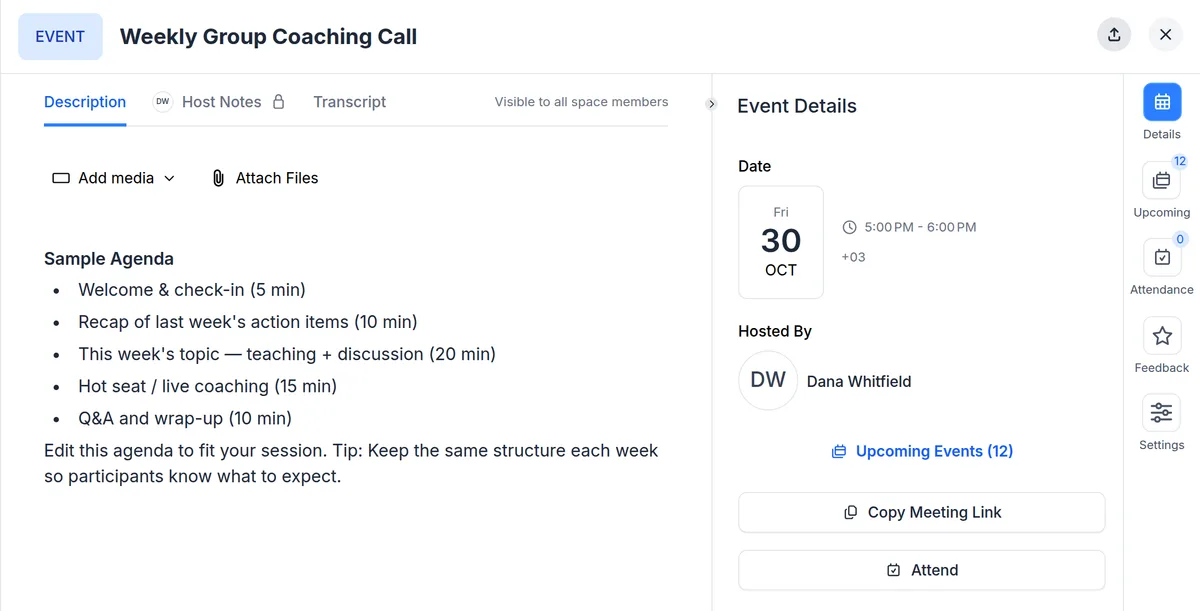
- 0:00Welcome & check-in5 min
- 0:05Action-item recap10 min
- 0:15This week's topic20 min
- 0:35Hot seat15 min
- 0:50Q&A and wrap-up10 min
The 12-week program: three phases, four weeks each
Most weeks pair your lesson with a worksheet participants do on their own time, then the live group call. Phases end with a short list of action items. Guides marked "for you" are notes for the facilitator: read them, then remove them before you publish.
- 1
Discovery
Orient participants, set baselines, build group trust.
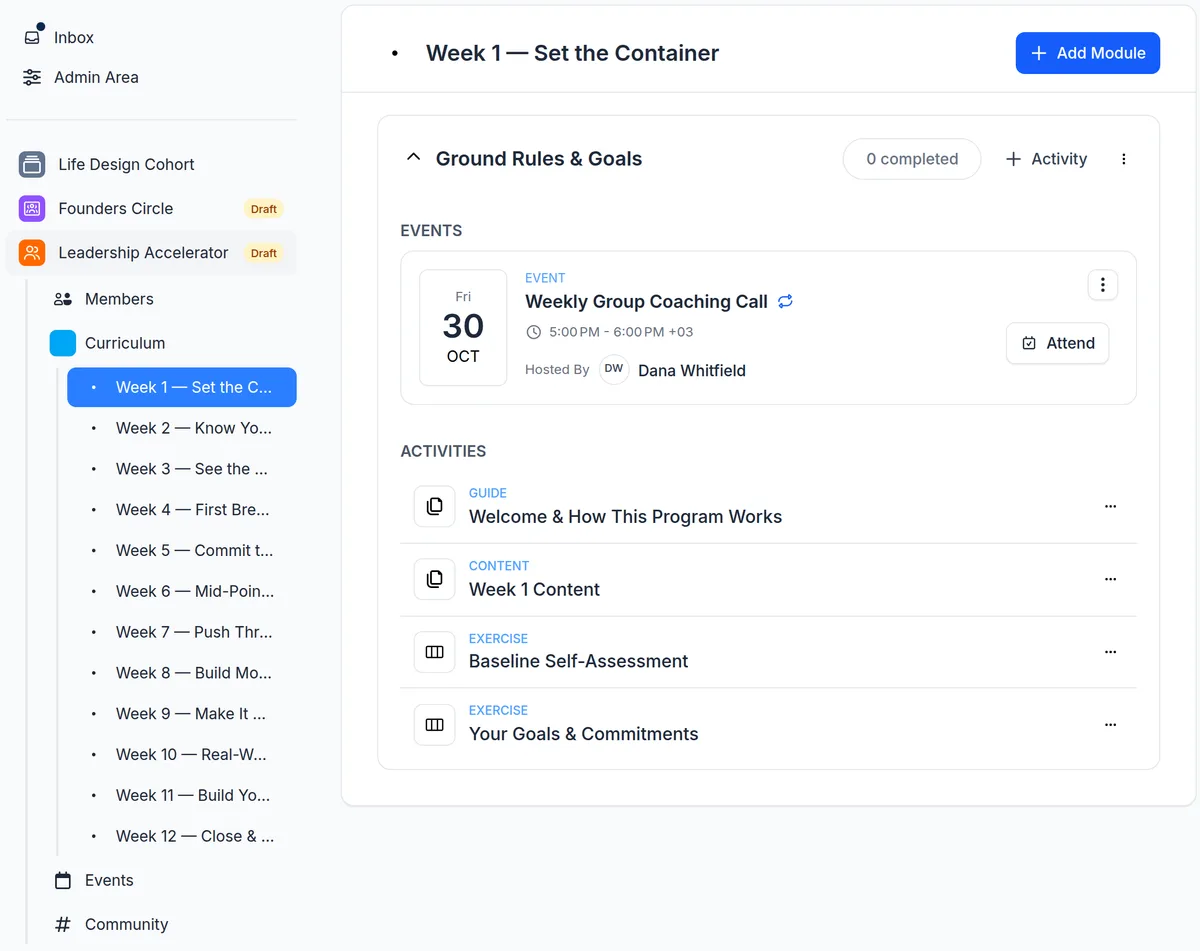
- Week 1
Set the Container
- Welcome & how this program works (guide for you)
- Lesson
- Baseline Self-Assessment
- Your Goals & Commitments worksheet
Participants fill in the baseline before the first call. You come back to it in week 6 and week 12.
- Week 2
Know Your Starting Point
- Lesson
- Where Are You Now? worksheet
- Week 3
See the Patterns
- Lesson
- Pattern Recognition worksheet
- Week 4
First Breakthrough
- Lesson
- Your First Shift worksheet
- Phase 1 action items
- Week 1
- 2
Building
Deepen the work, push through resistance, build momentum.
- Week 5
Commit to Change
- Lesson
- Accountability Contract worksheet
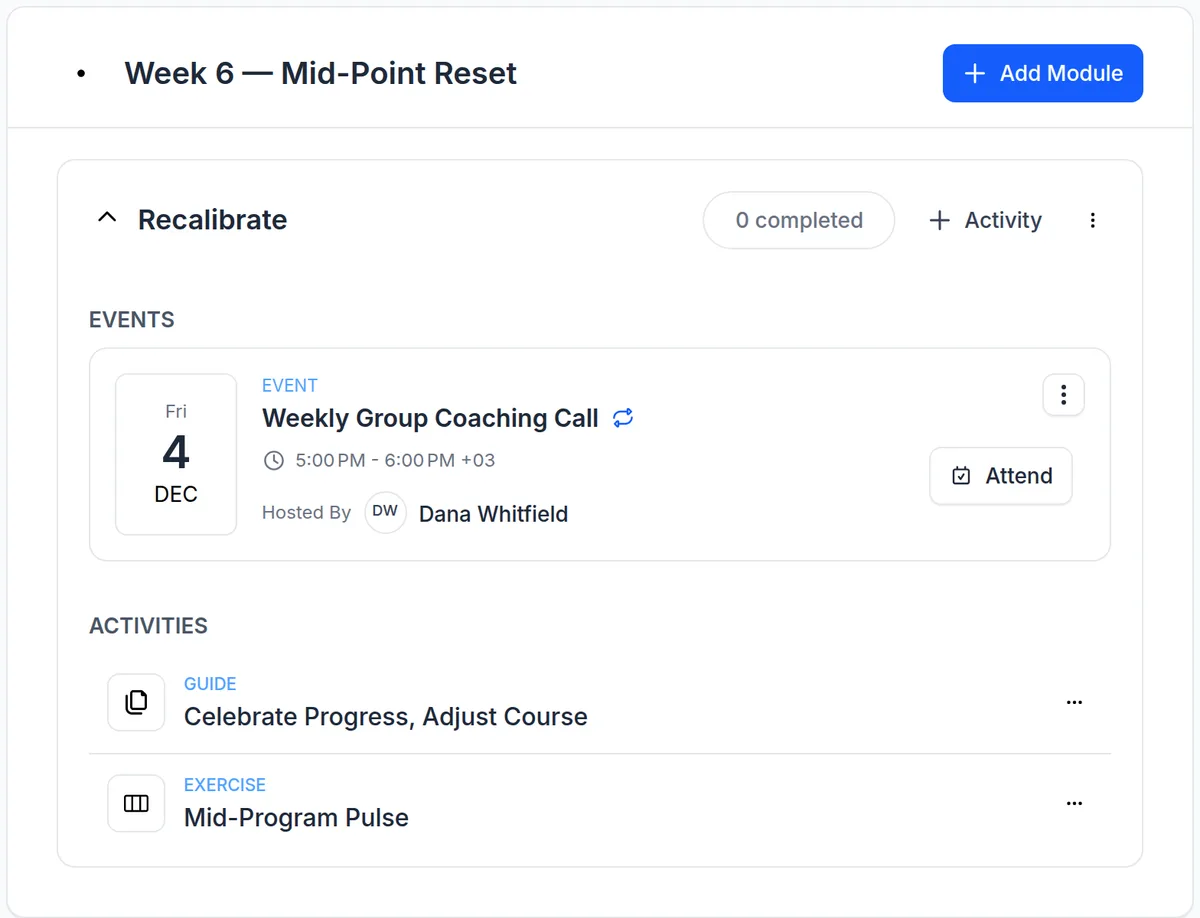
- Week 6
Mid-Point Reset
- Celebrate Progress, Adjust Course (guide for you)
- Mid-Program Pulse (private)
- Optional 30-minute 1:1 check-in, booked after a short call prep worksheet
Swap the usual call for a celebration and reset: wins, an honest check-in, what the Pulse showed, and a re-commit for the second half.
- Week 7
Push Through
- Lesson
- What's Holding You Back? worksheet
- Week 8
Build Momentum
- Lesson
- Progress Evidence worksheet
- Phase 2 action items
- Week 5
- 3
Integration
Solidify gains, build independence, close with impact.
- Week 9
Make It Yours
- Lesson
- Personalize Your Approach worksheet
- Week 10
Real-World Test
- Lesson
- Field Report worksheet
- Week 11
Build Your Toolkit
- Your Personal Playbook (guide for you)
- My Playbook worksheet
Run a share-your-playbook call: each participant shares one or two tools or practices they're keeping, and the group adds to them.
- Week 12
Close & Launch Forward
- Where You Started vs Where You Are (guide for you)
- Final Reflection & Outcomes
- Your Next Steps
Put each participant's baseline and final answers side by side on the last call, then a celebration round and a commitment round.
- Week 9
Group coaching session structure: one 60-minute call
The same five blocks every week, so participants know what to expect. Copy it into your calendar invite.
| Time | Block | What the facilitator does |
|---|---|---|
| 0:00–0:05 | Welcome & check-in5 min | A quick round: one word or one line from each participant on where they are this week. |
| 0:05–0:15 | Action-item recap10 min | Go through what each participant committed to last week. What got done, what didn't, and what got in the way. |
| 0:15–0:35 | This week's topic20 min | A short teaching point on the week's topic, then discussion. Participants come having read the lesson, so spend most of the time applying it to their own situations. |
| 0:35–0:50 | Hot seat15 min | Live coaching for one participant on a real challenge, while the group listens and adds perspective. Rotate who takes it each week. |
| 0:50–1:00 | Q&A and wrap-up10 min | Open questions, then everyone names one action item for the coming week. Those become next week's recap. |
Three checkpoints: before, midpoint, after
The final reflection mirrors the baseline, so you can put each participant's week 1 and week 12 answers side by side. Replace [your topic] with what your program is about.
Baseline Self-Assessment
- 1What are your top 3 goals for this program?
- 2How would you rate your current confidence or skill in [your topic]? (1 to 10)
- 3What does success look like for you at the end of this program?
- 4What have you already tried that hasn't worked?
- 5How committed are you to doing the work? (1 to 10)
Mid-Program Pulse
- 1How valuable has the program been so far? (1 to 10)
- 2What has been the most valuable element so far?
- 3What should we do more of? Less of?
- 4How would you rate your progress toward your goals? (1 to 10)
- 5Is there anything you need that you're not getting?
Final Reflection & Outcomes
- 1How would you now rate your confidence or skill in [your topic]? (1 to 10)
- 2Did you achieve your goals? Fully, partially, or not yet
- 3What was the biggest shift or transformation for you?
- 4How would you rate this program overall? (1 to 10)
- 5Would you recommend this program to a colleague or friend? (0 to 10)
- 6What was the most valuable element?
- 7Anything else you'd like to share?
Four rules for the facilitator
What makes the 12 weeks work.
Teach async, coach live
Put your teaching in the weekly lessons. Keep live time for Q&A, hot seats and peer coaching. Keep teaching on the call short.
Cap the group at 12–15
Larger groups shift from coaching to teaching. If you need a bigger cohort, split it into smaller pods.
Plan the midpoint
Energy dips around week 6. Read the Pulse answers before that call, look for who's stuck, and use the call to reset.
Measure before and after
The baseline and the final reflection show participants their progress in their own numbers.
What keeps the group going between calls
Participants do the week's work on their own time. These keep them connected and on schedule.
Community channel
One discussion channel for the whole group.
Member directory
Visible to all participants, so they can find and connect with each other.
Weekly release
Each week's section opens on schedule, counted from your start date.
Optional 1:1 check-in
A 30-minute private check-in at the midpoint, booked from the week 6 module. Needs a connected calendar.
Group coaching program template · upcoach.com/templates/group-coaching-program-template